 Ancient3DCrafts
The object · Hub
The Complaint Tablet to Ea-nasir
Key points
- An Old Babylonian clay letter from a man named Nanni to the copper merchant Ea-nasir, complaining about the wrong grade of copper.[1]
- British Museum number 131236, registration number 1953,0411.71, excavation number U.16814a, published as UET V 81.[1][3][4]
- Found at Ur in southern Iraq by Leonard Woolley's joint British Museum and Penn Museum expedition; the museum dates it to about 1750 BC.[1][3]
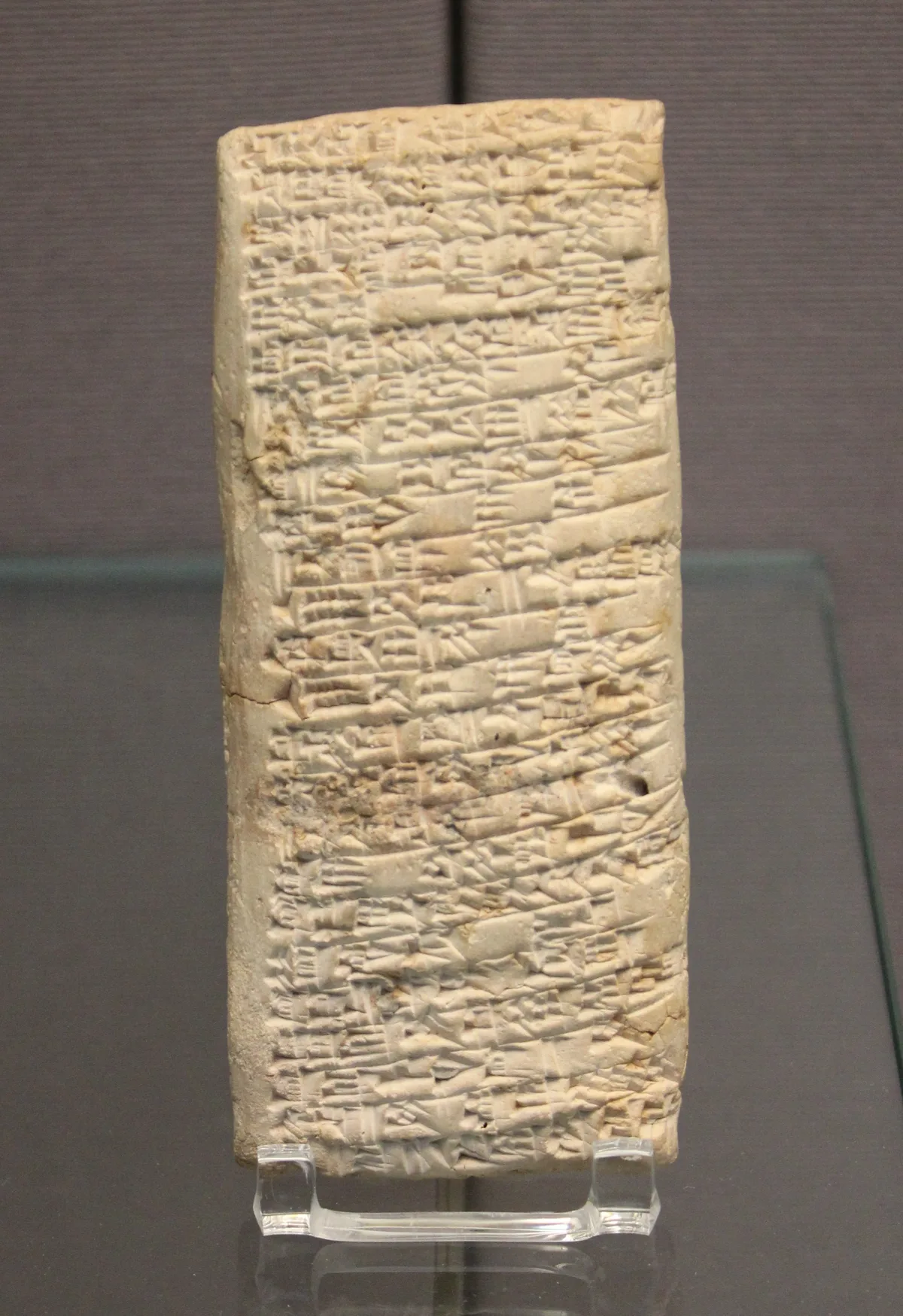
The object label
| Object | Clay tablet; letter from Nanni to Ea-nasir[1] |
|---|---|
| Period | Old Babylonian; production date given as 1750 BC[1] |
| Findspot | Ur (modern Tell al-Muqayyar), southern Iraq[1][2] |
| Excavated by | Sir Leonard Woolley, season 9 (1930–31)[1][3] |
| Museum number | 131236 (often written BM 131236)[1] |
| Registration number | 1953,0411.71[1] |
| Excavation number | U.16814a[1][3] |
| Publication | Figulla & Martin, Ur Excavations Texts V, no. 81 (UET V 81)[1][4] |
| Size | Height 11.6 cm, width 5 cm, thickness 2.6 cm[1] |
| Condition | Fair; slightly damaged[1] |
How does a modern copy compare? See size and materials: original vs replica, or learn to make out the opening lines yourself in how to read the Ea-nasir tablet.
A note on the numbers, because they get mixed up online. The British Museum gives every object a registration number based on when it was registered: 1953,0411.71 means the 71st item in a group registered on 11 April 1953. The older “big number” 131236 is the one Assyriologists usually cite. The registration number 1953,0411.1 belongs to a different tablet entirely, a Neo-Babylonian business agreement from the same excavation, so check the full number when you look it up.[1]
What it is
The tablet is a letter. In the Old Babylonian period, letters were written on small, hand-sized clay tablets, and this one is about the size of a modern phone. The British Museum's catalogue describes it as a letter from Nanni to Ea-nasir “complaining that the wrong grade of copper ore has been delivered after a gulf voyage and about misdirection and delay of a further delivery.” The text runs over both faces and onto the edges: the museum counts 23 lines on one face, 25 on the other and a few more on the edges.[1]
It is written in Akkadian, the main language of Mesopotamia at the time, using cuneiform signs pressed into damp clay with a reed stylus.[2][5] You can read more about the script in how cuneiform works, and about the content in what Nanni's letter says.
Where and when it was found
Woolley led the joint expedition of the British Museum and the University of Pennsylvania Museum at Ur from 1922 to 1934.[6][7] The UrOnline catalogue, which reunites the records of that excavation, lists this tablet under excavation number U.16814a from the ninth season, 1930–31, and records its find context from the catalogue card as “House 4 (Chapel) A.H”, in the residential quarter Woolley called AH.[3] The card groups it with several other letters addressed to Ea-nasir. Archibab, the Collège de France database of Old Babylonian texts, assigns it to the archive of Ea-nasir from the house Woolley numbered 1 Old Street.[4]
Some popular accounts say the tablet was found in 1953. That is the year it was registered in the British Museum after the division of finds with Iraq's Department of Antiquities, not the year it came out of the ground.[1][3] Read the full story of the dig in Woolley's excavation of Ur.
How old is it?
The British Museum gives a production date of 1750 BC.[1] Guinness World Records, which lists it as the oldest written customer complaint, uses the same date.[8] Other texts in Ea-nasir's archive are dated to the 11th and 19th regnal years of Rim-Sîn I, king of Larsa, whose reign is usually placed between 1823 and 1763 BC on the conventional middle chronology, so treat “about 1750 BC” as a round figure rather than a precise year.[9][10]
Why it matters
For historians, Nanni's letter is one of a group of business letters that show how Gulf trade actually worked: advance payments, agents carrying silver, copper arriving by boat from Dilmun, quality disputes and sealed documents lodged at a temple.[9][4] Those details are covered in Dilmun and the copper trade and who was Ea-nasir?
For everyone else, it is simply very relatable. Since 2015 the tablet has become one of the best-known objects in the British Museum online, thanks to a Reddit post and a decade of jokes, as told in why Ea-nasir became a meme.[11][12]
Condition and conservation
The museum records the tablet as slightly damaged but complete enough to read. The clay is described on the excavation catalogue card as unfired.[3][1] According to Wikipedia, the inscription was stabilised with the conservation resin Paraloid B-72 in 2009.[13]
The original is fragile and, at the time of writing, the museum's online record lists it as not on display; see how to see the Ea-nasir tablet before planning a visit. If you'd like one on your own shelf, our Ea-nasir tablet replica is close to life size and reproduces the inscribed front face.
FAQ
What is the museum number of the Ea-nasir tablet?
British Museum number 131236; registration number 1953,0411.71.
Who found the complaint tablet?
Sir Leonard Woolley's joint British Museum and Penn Museum expedition at Ur, in the 1930–31 season according to UrOnline.
How big is the original tablet?
11.6 cm high, 5 cm wide and 2.6 cm thick, according to the British Museum.
Sources
- [1] British Museum, collection record: tablet, museum number 131236, registration 1953,0411.71
- [2] Cuneiform Digital Library Initiative, “UET 5, 0081 (P414985)”
- [3] UrOnline (British Museum and Penn Museum), object record “16814A | 1953,0411.71”
- [4] Archibab (Collège de France), text T12972 = UET 5 81, “Lettre de Nanni à Ea-naṣir”, transliteration and translation
- [5] Wikipedia, “Cuneiform” (accessed Nov 2026)
- [6] UrOnline, home page: excavations at Ur 1922–1934
- [7] Wikipedia, “Leonard Woolley” (accessed Nov 2026)
- [8] Guinness World Records, “Oldest written customer complaint”
- [9] Wikipedia, “Ea-nāṣir” (accessed Nov 2026)
- [10] Wikipedia, “Rim-Sîn I” (accessed Nov 2026)
- [11] Know Your Meme, “Complaint Tablet to Ea-nasir”
- [12] M. Hale, “The Internet's Favorite Sumerian,” Cultural Property News, 1 Sep 2024
- [13] Wikipedia, “Complaint tablet to Ea-nāṣir” (accessed Nov 2026)