 Ancient3DCrafts
Museum guide
How to See the Ea-nasir Tablet at the British Museum
Key points
Is it on display?
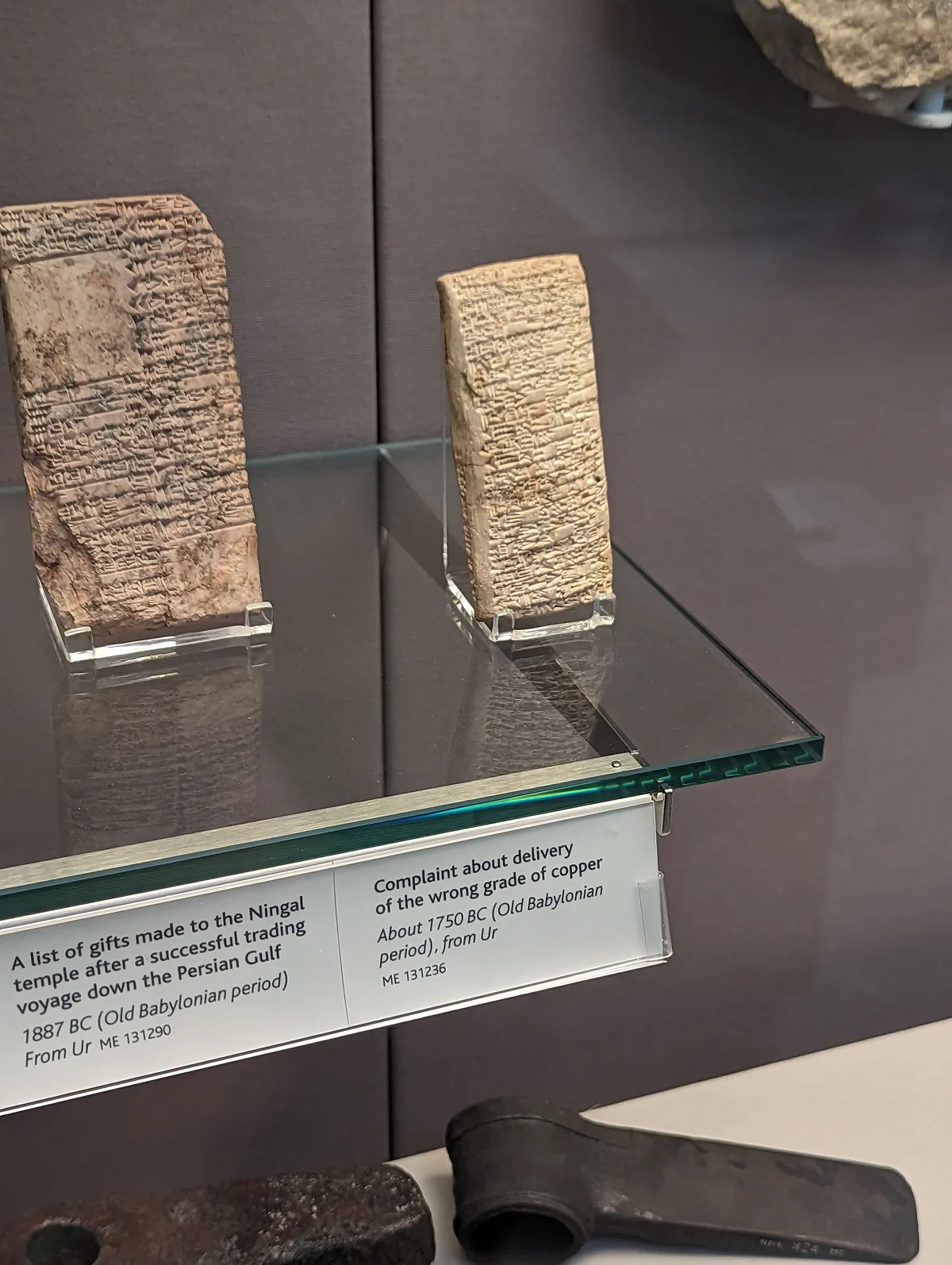
Not reliably. The British Museum's collection record for 131236 gives its location as “Not on display” when we checked in November 2026.[1] It has been displayed in the past: the 2015 Reddit photo that launched the meme showed it in a case with its label, and a visitor photographed it on display in September 2023 (the photo at the top of this page).[2] Fragile objects are rotated, lent and rested, so the only way to know is to check the record shortly before you go.
When it is shown, look for it in Room 56: the archaeologist Gabriel Moshenska, writing in the Journal of Contemporary Archaeology, described it on display there alongside copper artefacts, with a label reading “Complaint about delivery of the wrong grade of copper”.[3]
How to check before you go
- Open the British Museum collection search and search for 131236 or 1953,0411.71.[1]
- Look at the Location line on the record. A room number means it is on display; “Not on display” means it isn't.
- Check opening times and any ticketed exhibitions on the museum's website. General entry to the museum is free.[1]
The museum is on Great Russell Street, London WC1B 3DG.[1]
Why objects go off display
Museums show only a small fraction of their collections at any time. The British Museum holds around 130,000 cuneiform tablets, far more than any gallery could display.[4] Objects are also rested to limit exposure to light and handling, lent to other museums, studied, photographed or moved when galleries are redesigned. Nanni's letter is unfired clay and has already needed conservation treatment, so periods off display are to be expected.[5][6] None of this means it has gone anywhere: it remains in the collection under museum number 131236.[1]
What else from Ur to see in London
The British Museum holds a large share of the finds from Woolley's excavations at Ur, which were divided between Baghdad, London and Philadelphia.[7] Its Mesopotamian galleries have long featured material from Ur's Royal Cemetery. Even if Nanni's letter is resting, you can see the world it came from. Read Woolley's excavation of Ur before you go.
Ur elsewhere in the world
Half of the Ur finds went to the Iraq Museum in Baghdad, and a quarter to the Penn Museum in Philadelphia, so the story of Ur can be followed on three continents.[7][8] The site of Ur itself, Tell al-Muqayyar near Nasiriyah, with its restored ziggurat, lies in southern Iraq.[7][9]
See it online
- British Museum collection online: the official record, with dimensions and bibliography.[1]
- UrOnline: the excavation record for U.16814a, including the catalogue card.[5]
- CDLI: the Cuneiform Digital Library Initiative entry P414985, with a transliteration.[10]
- Archibab: a line-by-line transliteration and translation (text T12972).[11]
- Wikimedia Commons: freely licensed photos of both faces, used on this site with credit (see our image licence page).
Or start here with the complaint tablet explained and what the letter says.
Visiting tips
If it is on display, the tablet is small: about 11.6 cm high.[1] Bring reading glasses if you need them, and look at it from the side to see the wedges catch the light. The text runs over the edges, so walk around the case if you can. If you'd rather study it at home, our Ea-nasir tablet replica is close to life size and reproduces the inscribed front face.
FAQ
Is the Ea-nasir tablet on display at the British Museum?
At the time of writing the museum's online record lists it as not on display. Check the record for 131236 before visiting.
Is the British Museum free?
General entry is free; some exhibitions are ticketed.
Where else can I see finds from Ur?
The Iraq Museum in Baghdad and the Penn Museum in Philadelphia also hold Ur finds.
Sources
- [1] British Museum, collection record: tablet, museum number 131236, registration 1953,0411.71
- [2] Know Your Meme, “Complaint Tablet to Ea-nasir”
- [3] G. Moshenska, “The Legend of Ea-Naṣir: How a Babylonian Businessman Became an Internet Meme,” Journal of Contemporary Archaeology
- [4] Wikipedia, “Cuneiform” (accessed Nov 2026)
- [5] UrOnline (British Museum and Penn Museum), object record “16814A | 1953,0411.71”
- [6] Wikipedia, “Complaint tablet to Ea-nāṣir” (accessed Nov 2026)
- [7] UrOnline, “The UrOnline Project”
- [8] W. B. Hafford, “City of the Moon: New Excavations at Ur,” Expedition (Penn Museum), 2017
- [9] Wikipedia, “Ur” (accessed Nov 2026)
- [10] Cuneiform Digital Library Initiative, “UET 5, 0081 (P414985)”
- [11] Archibab (Collège de France), text T12972 = UET 5 81, “Lettre de Nanni à Ea-naṣir”, transliteration and translation