 Ancient3DCrafts
Writing · Guide
How to Read the Ea-nasir Tablet
Key points
Before you start
Nobody reads cuneiform straight off a photo on day one. Specialists work from transliterations, sign-by-sign renderings in Latin letters, and from hand copies of the tablet. This guide uses the transliteration and English translation published by Archibab, the Collège de France database of Old Babylonian texts, for UET V 81, Nanni's letter.[1] If the script itself is new to you, read how cuneiform works first.
Three conventions to know: syllables in one word are joined by hyphens (qí-bí-ma); Sumerian word-signs are written in capitals (URUDU, copper); and silent classifiers are written as superscripts, like the ᵈ that marks a god's name.[1][2] Accents and subscript numbers tell you which of several signs with the same sound the scribe used.
Which way up?
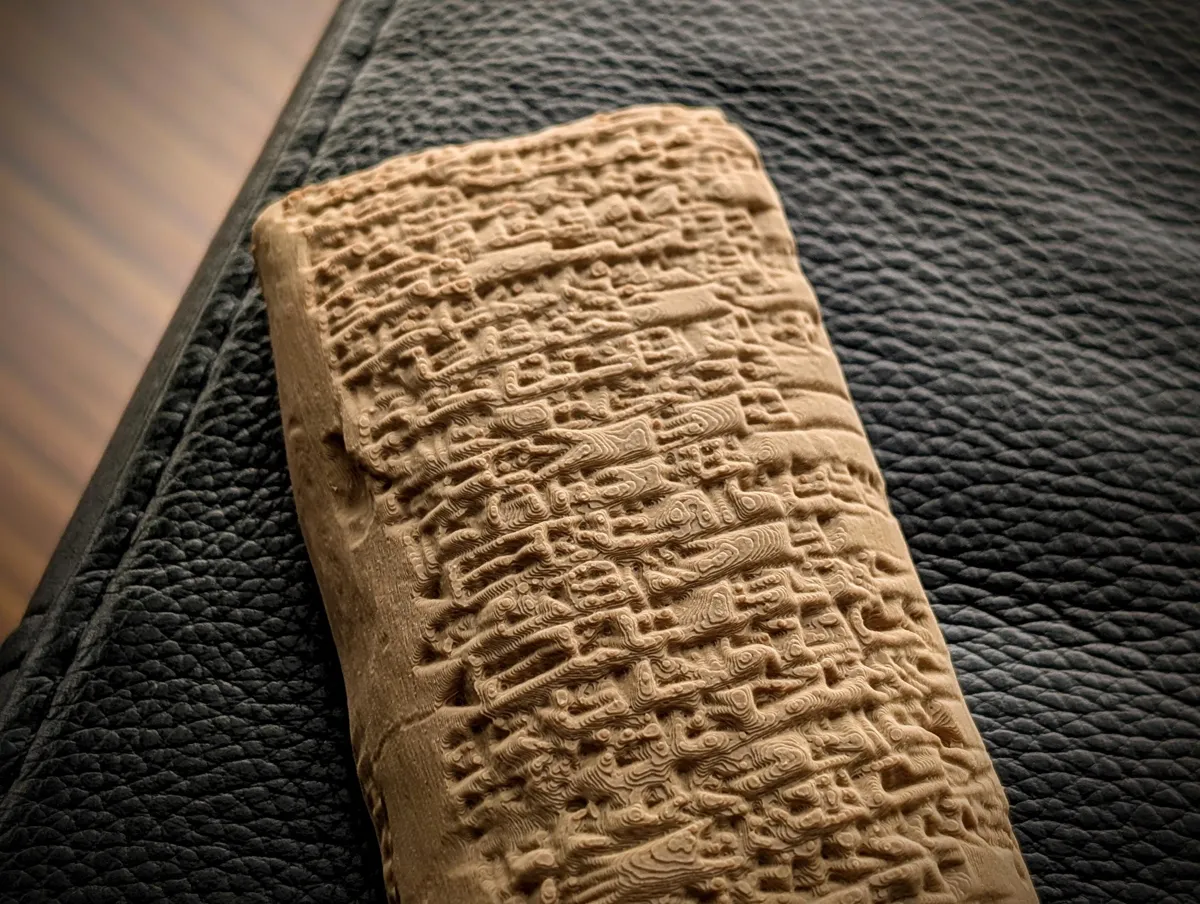
Hold the tablet upright, the long way. The text starts at the top left of the obverse (the flatter face) and runs in horizontal lines from left to right. When the scribe reached the bottom, the tablet was turned over along its lower edge, so the reverse continues upside-down relative to the front if you flip it like a book page. Nanni's letter fills both faces and carries on along the edges; the British Museum counts 23 + 25 + 3 + 2 lines.[3] You can see the text wrapping onto the edge in the photos of the original.
Lines 1–3: the address
| Line | Transliteration | Meaning |
|---|---|---|
| 1 | a-na é-a-na-ṣi-ir | To Ea-nasir |
| 2 | qí-bí-ma | speak! |
| 3 | um-ma na-an-ni-ma | Thus (says) Nanni: |
Line 1 is ana, “to”, followed by the name. The name is spelled é-a-na-ṣi-ir: Ea is the god of fresh water and wisdom, and nāṣir is usually understood as “protector”. Line 2, qí-bí-ma, is an order to the person reading the letter aloud: “speak”. Line 3, umma ... -ma, introduces quoted speech: “thus Nanni”.[1] Every Old Babylonian letter starts like this, so it's the best place to begin. Most letters then add a blessing; Nanni's goes straight to business.[4]
Lines 4–8: the promise
| Line | Transliteration | Meaning (after Archibab) |
|---|---|---|
| 4–5 | a-nu-ú-ma ta-al-li-ku / ki-a-am ta-aq-bi-am | When you went away, you promised me as follows, |
| 6 | um-ma at-ta-a-ma | in your words: |
| 7 | gu-ba-ri da-am-qú-tim | “good ingots |
| 8 | a-na ig-mil-ᵈEN.ZU a-na-ad-di-in | I will give to Igmil-Sin.” |
Two things to spot. gu-ba-ri is the word for ingots, and damqūtim means good.[1] In line 8 the name of Nanni's man contains ᵈEN.ZU: the superscript d marks a god, and EN.ZU is a Sumerian spelling of Sîn, the moon god of Ur. Oppenheim read the name as Gimil-Sin; Archibab reads Igmil-Sin.[5][1]
Lines 14–15: take it or leave it
The line everybody knows sits a little further down: te-le-qé-a li-qé-a ... at-la-ka. Archibab translates it “If you want to take it, take it; if you do not want to take it, go away!”, close to Oppenheim's wording.[1][5] The repeated leqû, “to take”, makes the brush-off sound as curt in Akkadian as it does in English.
Line 26: “those going to Dilmun”
Line 26 reads a-li-ik te-el-mu-un, “those who go to Dilmun”, the merchants' own name for their trade group. It's the phrase behind the term alik Tilmun used for Ea-nasir and his colleagues.[1][6] Read more in Dilmun and the copper trade.
Line 37: reading numbers
On the reverse, line 37 reads 18 GÚ URUDU i-di-in: “gave 18 talents of copper”. The number is written with wedges, followed by two Sumerian word-signs, GÚ (talent) and URUDU (copper), then the Akkadian verb spelled out in syllables.[1] It's a neat example of how scribes mixed systems in one line.
Practise with a replica
Wedges are much easier to read in three dimensions than in a flat photo. Put a lamp low to one side so its light rakes across the surface, then match the shapes to a sign list. Our Ea-nasir tablet replica reproduces the inscribed front face of the tablet at close to life size for exactly this, so you can follow the opening lines on it; for the reverse, including line 37, use the museum photographs. When you're done, compare your reading with the translation summary.
FAQ
How does Nanni's letter begin in Akkadian?
a-na é-a-na-ṣi-ir / qí-bí-ma / um-ma na-an-ni-ma: “To Ea-nasir speak; thus says Nanni.”
What does URUDU mean?
It is the Sumerian word-sign for copper, used inside the Akkadian text.
Where can I see a full transliteration?
Archibab (text T12972) and the Cuneiform Digital Library Initiative (P414985) publish it online.
Sources
- [1] Archibab (Collège de France), text T12972 = UET 5 81, “Lettre de Nanni à Ea-naṣir”, transliteration and translation
- [2] Wikipedia, “Cuneiform” (accessed Nov 2026)
- [3] British Museum, collection record: tablet, museum number 131236, registration 1953,0411.71
- [4] Wikipedia, “Ea-nāṣir” (accessed Nov 2026)
- [5] A. Leo Oppenheim, Letters from Mesopotamia: Official, Business, and Private Letters on Clay Tablets from Two Millennia (University of Chicago Press, 1967), letter no. 12, pp. 82–83
- [6] Wikipedia, “Complaint tablet to Ea-nāṣir” (accessed Nov 2026)
- [7] Cuneiform Digital Library Initiative, “UET 5, 0081 (P414985)”