 Ancient3DCrafts
Writing
How Cuneiform Works
Key points
- Cuneiform is a logo-syllabic script: its signs stand for words, syllables or classifiers.[1]
- It was made by pressing a cut reed into damp clay, leaving wedge-shaped marks (Latin cuneus, wedge).[1]
- Invented for Sumerian at Uruk around the end of the 4th millennium BC, it was later used for Akkadian, the language of Nanni's letter.[1][5]
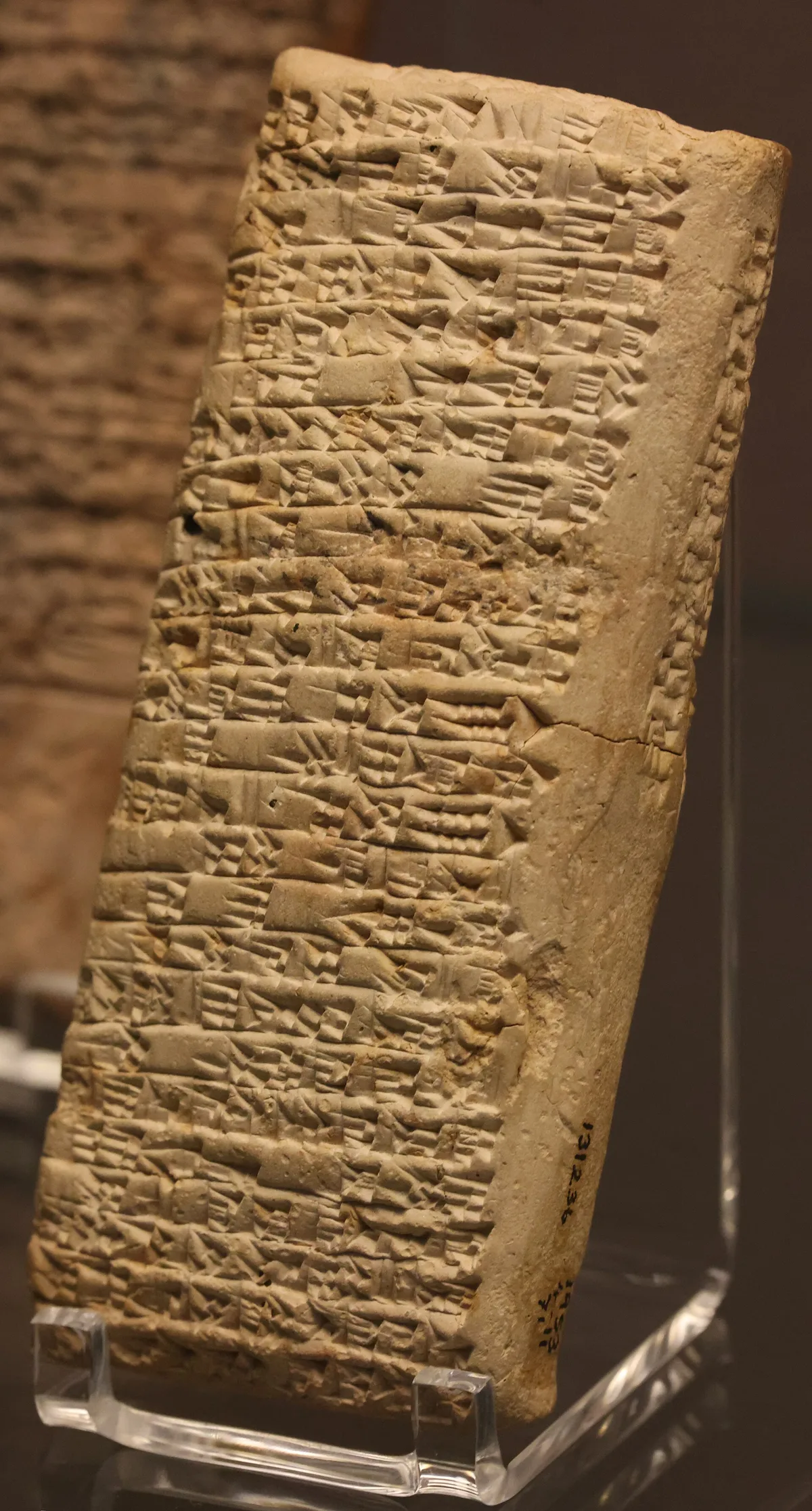
From tokens to tablets
Writing in Mesopotamia grew out of accounting. Clay tokens were used to keep track of goods, then impressed onto clay envelopes, and eventually replaced by flat tablets with signs drawn on them. The first true writing appears at Uruk at the end of the 4th millennium BC.[1] Early signs were pictures drawn in the clay; over time they became stylised clusters of wedges, made by pressing rather than drawing.[1]
How a sign was made
A scribe held a reed stylus cut to a sharp edge and pressed its corner into a damp clay tablet. Each press left a small triangular head with a tail: a wedge. Signs were built from horizontal, vertical and diagonal wedges, plus a small hook-shaped mark. Because the clay had to stay damp, a letter was written in one sitting, and everyday tablets were often simply left to dry rather than fired in a kiln. Nanni's letter, according to Woolley's catalogue card, is unfired clay.[2] Look closely at the original tablet and you can see the rows of wedges running right to the edge, and over it.
One script, many languages
Cuneiform was created for Sumerian, but it was adapted to write Akkadian from the 24th century BC onward, and Akkadian texts make up most of the surviving record. It was later used for Hittite, Elamite, Hurrian, Urartian and others. The script was in use for more than three thousand years; the latest firmly dated tablet, from Uruk, dates to AD 79/80.[1]
By Ea-nasir's time, the spoken language of Ur was Akkadian, but scribes still used many Sumerian word-signs inside Akkadian sentences, the way English uses “&” or “%”.[1][3]
Three kinds of sign
Cuneiform mixes three kinds of sign:
- Syllables. Most Akkadian words are spelled out syllable by syllable: qí-bí-ma, “speak”.[3]
- Logograms (word-signs). A single Sumerian sign stands for a whole word, read in Akkadian. In Nanni's letter, URUDU means copper and GÚ means talent.[3]
- Determinatives. Silent classifiers placed before or after a word to show what kind of thing it is: a god, a city, a wooden object. The sun god Šamaš is written ᵈUTU, where the superscript d marks a deity.[1][3]
Because many signs have several possible values, readers rely on context, which is why Assyriologists sometimes disagree over a name: Oppenheim read Nanni's agent as Gimil-Sin, while Archibab reads Igmil-Sin.[4][3]
How it was deciphered
Cuneiform was rediscovered by Europeans in the 17th century through the trilingual royal inscriptions of Persepolis, and deciphered in the 19th century. By 1857 the script was considered deciphered.[1] An estimated half a million tablets are held in museums worldwide; the British Museum alone has about 130,000.[1] Most will never become famous. Nanni's happened to be funny.
Try it yourself
The best way to understand cuneiform is to look at it in raking light, with a sign list beside you. Our next guide, how to read the Ea-nasir tablet, walks through the first lines sign by sign. The Ea-nasir tablet replica gives you the wedges in three dimensions to follow along, and the translation summary tells you what they say.
FAQ
What does cuneiform mean?
Wedge-shaped, from the Latin cuneus, 'wedge', after the marks a reed stylus leaves in clay.
Is cuneiform an alphabet?
No. It is a logo-syllabic script with signs for words, syllables and silent classifiers.
What was cuneiform written with?
A cut reed stylus pressed into damp clay.
Sources
- [1] Wikipedia, “Cuneiform” (accessed Nov 2026)
- [2] UrOnline (British Museum and Penn Museum), object record “16814A | 1953,0411.71”
- [3] Archibab (Collège de France), text T12972 = UET 5 81, “Lettre de Nanni à Ea-naṣir”, transliteration and translation
- [4] A. Leo Oppenheim, Letters from Mesopotamia: Official, Business, and Private Letters on Clay Tablets from Two Millennia (University of Chicago Press, 1967), letter no. 12, pp. 82–83
- [5] Cuneiform Digital Library Initiative, “UET 5, 0081 (P414985)”