 Ancient3DCrafts
The replica
Ea-nasir Tablet Size and Materials: Original vs Replica
Key points
- Original: 11.6 cm high, 5 cm wide, 2.6 cm thick, clay.[1]
- Replica: 11.5 cm tall, 5 cm wide, 2 cm thick, solid clay-effect composite.[2]
- The replica keeps the original's height and width, is a little thinner, and weighs 100 g.
- The replica reproduces the inscribed front face only; the original's back and edges are not reproduced.
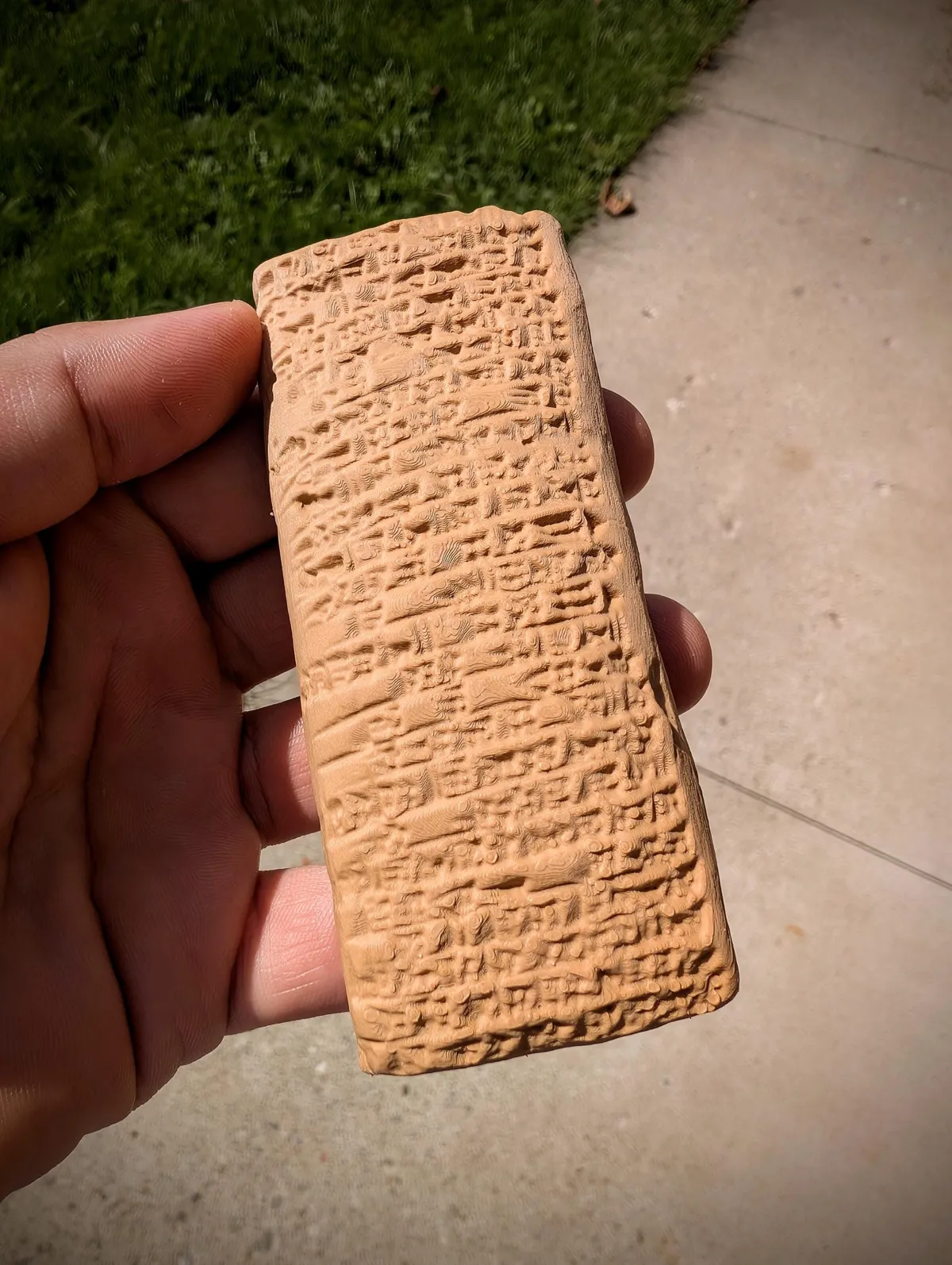
Side by side
| Original (BM 131236) | Our replica | |
|---|---|---|
| Height | 11.6 cm[1] | 11.5 cm[2] |
| Width | 5 cm[1] | 5 cm[2] |
| Thickness | 2.6 cm[1] | 2 cm[2] |
| Material | Clay, recorded as unfired[1][3] | Solid clay-effect composite[2] |
| Made | Ur, c. 1750 BC[1] | Richmond Hill, Ontario, 2026 |
| Weight | Not published by the museum | 100 g |
| Inscribed surfaces | Front, back and edges[1] | Front face only |
The UrOnline catalogue card, transcribed from the British Museum's index card, gives 115 mm by 50 mm, which differs from the museum's current online measurement by a millimetre. Small differences like this are normal between old catalogue cards and modern records.[3][1]
How big is that in real life?
At 11.5 cm by 5 cm, the replica sits comfortably in an open palm, as the photos show. It's about the footprint of a phone, and a little thinner than many. That is the real scale of an Old Babylonian letter: these were personal, portable documents, written quickly on a tablet small enough to carry in a bag.[1] For more on how letters were written, see how cuneiform works.
Which faces are reproduced?
Nanni's letter fills the front of the original, carries on across the back and runs onto the edges: the British Museum counts 23 lines on one face, 25 on the other and a few more on the edges.[1] Our replica reproduces the inscribed front face only. The back and edges are not reproduced, so the replica shows the opening of the letter, starting with the address “To Ea-nasir speak”, but not its continuation on the back. For the rest of the text, see what Nanni's letter says.
Weight
The replica weighs 100 g, a hefty piece for something the size of a phone, which helps it sit steadily on a desk or stand on its end. The British Museum does not publish a weight for the original.[1]
The material
The original is made of clay. Woolley's catalogue card describes it as unfired, meaning it was left to dry rather than baked in a kiln, which is one reason it is fragile and has been treated with conservation resin.[3][4] We don't use real clay for the replica, because a dried-clay copy would chip and crack with handling. Instead it is made from a solid, sturdy composite with a clay-like look and feel, designed to withstand use as a teaching tool or a prop.[2] Each piece is finished by hand in our workshop.
Colour
The replica is a warm sandy clay colour, as shown in the listing photos; colour can look slightly different between screens and lighting. The original, in museum photographs, is a pale clay with darker patches and some surface damage.[1] Some buyers paint their replicas: one Etsy reviewer said they painted theirs “to look plaster”.[5]
Reading the replica
Because the replica keeps the original's height and width, the rows of wedges sit at roughly the same spacing as on the real tablet, which makes it useful for practice. Set a desk lamp low to one side so the light skims across the inscribed front face: the wedges throw small shadows and the signs stand out, just as they do in museum photographs taken in raking light. Then follow the opening lines with our guide how to read the Ea-nasir tablet, starting with “To Ea-nasir speak; thus says Nanni.”[6] Teachers use the same trick to show a class how a scribe's stylus built each sign from a few presses.
Care
- Dust with a soft, dry brush; a soft toothbrush gets into the wedges.
- Avoid soaking it or using solvents, which can affect the surface finish.
- Keep it out of high heat, such as a car dashboard in summer: like most plastics, the composite can soften if it gets very hot.
- If you paint it, test acrylics on the plain back first.
Display ideas
The replica lies flat or stands on its end; one reviewer said they love that it stands.[5] A small plate stand or easel shows the inscribed face; a shadow box works for a wall. Pair it with a printed copy of the translation summary.
Next steps
Compare options in the replica buying guide, look at gift ideas in Ea-nasir gifts, or go straight to the Ea-nasir tablet replica. Questions about ordering and exchanges are answered in the FAQ.
FAQ
How big is the Ea-nasir replica?
11.5 cm tall, 5 cm wide and 2 cm thick.
How big is the original?
11.6 cm high, 5 cm wide and 2.6 cm thick, according to the British Museum.
How much does the replica weigh?
100 g.
Does the replica reproduce the back of the tablet?
No. It reproduces the inscribed front face only.
Sources
- [1] British Museum, collection record: tablet, museum number 131236, registration 1953,0411.71
- [2] Ancient3DCrafts, Etsy listing “Ea-Nasir Complaint Tablet Replica”
- [3] UrOnline (British Museum and Penn Museum), object record “16814A | 1953,0411.71”
- [4] Wikipedia, “Complaint tablet to Ea-nāṣir” (accessed Nov 2026)
- [5] Ancient3DCrafts, Etsy shop page and policies
- [6] Archibab (Collège de France), text T12972 = UET 5 81, “Lettre de Nanni à Ea-naṣir”, transliteration and translation