 Ancient3DCrafts
People
Who Was Ea-nasir?
Key points
- Ea-nasir was a merchant at Ur who belonged to the alik Tilmun, the “Dilmun traders” who shipped copper up the Gulf.[2][3]
- Dated texts place his activity in the reign of Rim-Sîn I of Larsa (11th and 19th regnal years).[2]
- Much of what survives of his archive is complaints, most famously Nanni's letter.[2][4]
A merchant in the Gulf trade
Almost everything we know about Ea-nasir comes from clay tablets found in one house at Ur. The Dutch scholar W. F. Leemans, who studied them in his 1960 book on Old Babylonian foreign trade, described him as a wholesale merchant who bought copper in Dilmun and brought it by water to Ur, where he sold it on to other traders.[1][2] He belonged to a group known in the texts as alik Tilmun, literally “those who go to Dilmun”.[3][4] Leemans thought his main business was probably supplying copper to the palace, and that his private customers may have come second.[2]
The copper itself seems to have come originally from Magan, the region of modern Oman and the United Arab Emirates, passing through Dilmun's markets on the way north.[2][5] Read more in Dilmun and the copper trade.
When did he live?
Texts in his archive are dated to the 11th and 19th years of Rim-Sîn I, the long-reigning king of Larsa, whose rule over southern Mesopotamia (including Ur) is usually dated 1823–1763 BC on the middle chronology.[2][6] Rim-Sîn was eventually defeated by Hammurabi of Babylon. The British Museum dates Nanni's letter to about 1750 BC, so Ea-nasir's career sits somewhere in the late 19th to mid-18th century BC, depending on whose dating you follow.[7]
His house at Ur
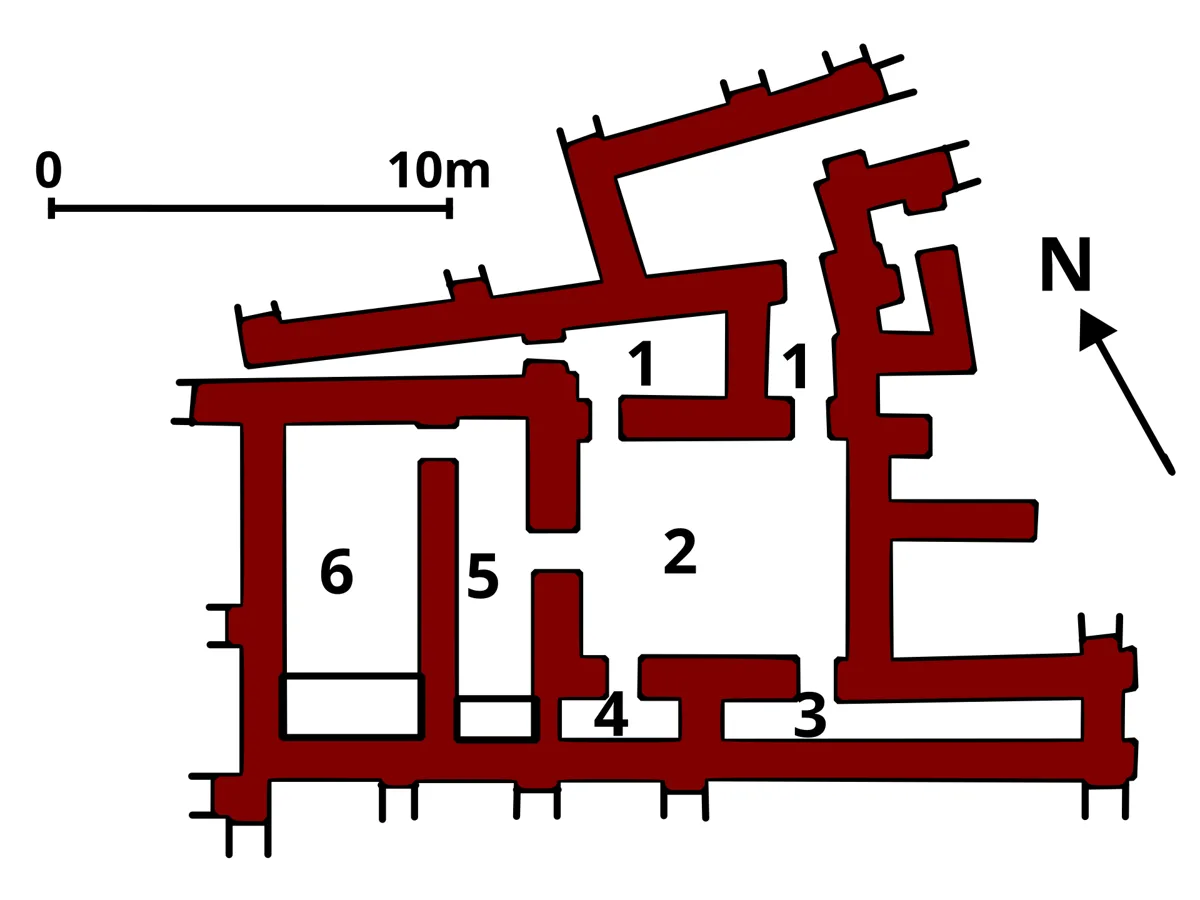
Woolley's team gave the house where the archive turned up the address “Number 1 Old Street”, in the excavation area called AH. Like its neighbours, it was built of mud brick and had its own small chapel.[2][4][8] The plan above, redrawn from Woolley and Mallowan's 1976 excavation report, shows how compact these town houses were. UrOnline's record for Nanni's letter gives the find context as “House 4 (Chapel) A.H”, which fits letters being kept in a back room of a merchant's home.[9]
Leemans noticed that part of the house seems to have been split off and joined to a neighbour's, perhaps during Ea-nasir's lifetime. That has been read as a sign of shrinking fortunes, though it may also have happened after his death.[2] For the dig that uncovered the house, see Leonard Woolley's excavation of Ur.
The complaints
What makes Ea-nasir memorable is how many of the letters to him are angry. Besides Nanni, a man named Arbituram wrote more than once that his copper had not arrived; others named Appa, Ilsu-ellatsu and Ili-idinnam also complained to him by name, and one correspondent said he was tired of receiving poor-quality copper.[2] Leemans pointed out that Nanni and Arbituram skip the polite blessing that normally opens an Old Babylonian letter, which says a lot about the tone.[2]
Nanni's own letter is summarised line by line in what Nanni's letter says. Michael Rice, writing about the archaeology of the Gulf, described the letters to Ea-nasir as gleaming “mischievously” amid much drier business records.[2]
Why would he keep complaint letters?
Nobody knows for sure. Popular retellings sometimes say he kept the complaints as trophies, but there is no evidence for that. A more ordinary explanation is that merchants kept their correspondence as records of debts, deliveries and disputes, and letters that were never resolved stayed in the archive. The surviving group is also the result of what happened to survive and be dug up, so it may not represent his business as a whole.[2][4]
The trophy story is one of several myths that came with the Ea-nasir meme.
What did he look like?
We have no portrait of Ea-nasir. The bearded, wide-eyed statue often used for him in memes is a worshipper figure from the Tell Asmar hoard, roughly a thousand years older than he is.[2] The only object that really belongs to his story is the tablet itself, which you can see in the complaint tablet explained, or hold in replica form with our Ea-nasir tablet replica.
FAQ
Was Ea-nasir a real person?
Yes. He is known from cuneiform tablets found in a house at Ur, dated to the reign of Rim-Sîn I of Larsa.
What did Ea-nasir sell?
Mainly copper ingots brought from Dilmun, and occasionally other goods according to Leemans.
Did Ea-nasir keep the complaints as trophies?
There is no evidence for that. Merchants commonly kept correspondence as business records.
Sources
- [1] W. F. Leemans, Foreign Trade in the Old Babylonian Period (Leiden: Brill, 1960), pp. 39–40
- [2] Wikipedia, “Ea-nāṣir” (accessed Nov 2026)
- [3] Wikipedia, “Complaint tablet to Ea-nāṣir” (accessed Nov 2026)
- [4] Archibab (Collège de France), text T12972 = UET 5 81, “Lettre de Nanni à Ea-naṣir”, transliteration and translation
- [5] Wikipedia, “Magan (civilization)” (accessed Nov 2026)
- [6] Wikipedia, “Rim-Sîn I” (accessed Nov 2026)
- [7] British Museum, collection record: tablet, museum number 131236, registration 1953,0411.71
- [8] L. Woolley and M. Mallowan, The Old Babylonian Period, Ur Excavations VII (London: British Museum Publications, 1976)
- [9] UrOnline (British Museum and Penn Museum), object record “16814A | 1953,0411.71”