 Ancient3DCrafts
Buying guide
Ea-nasir Tablet Replica Buying Guide
Key points
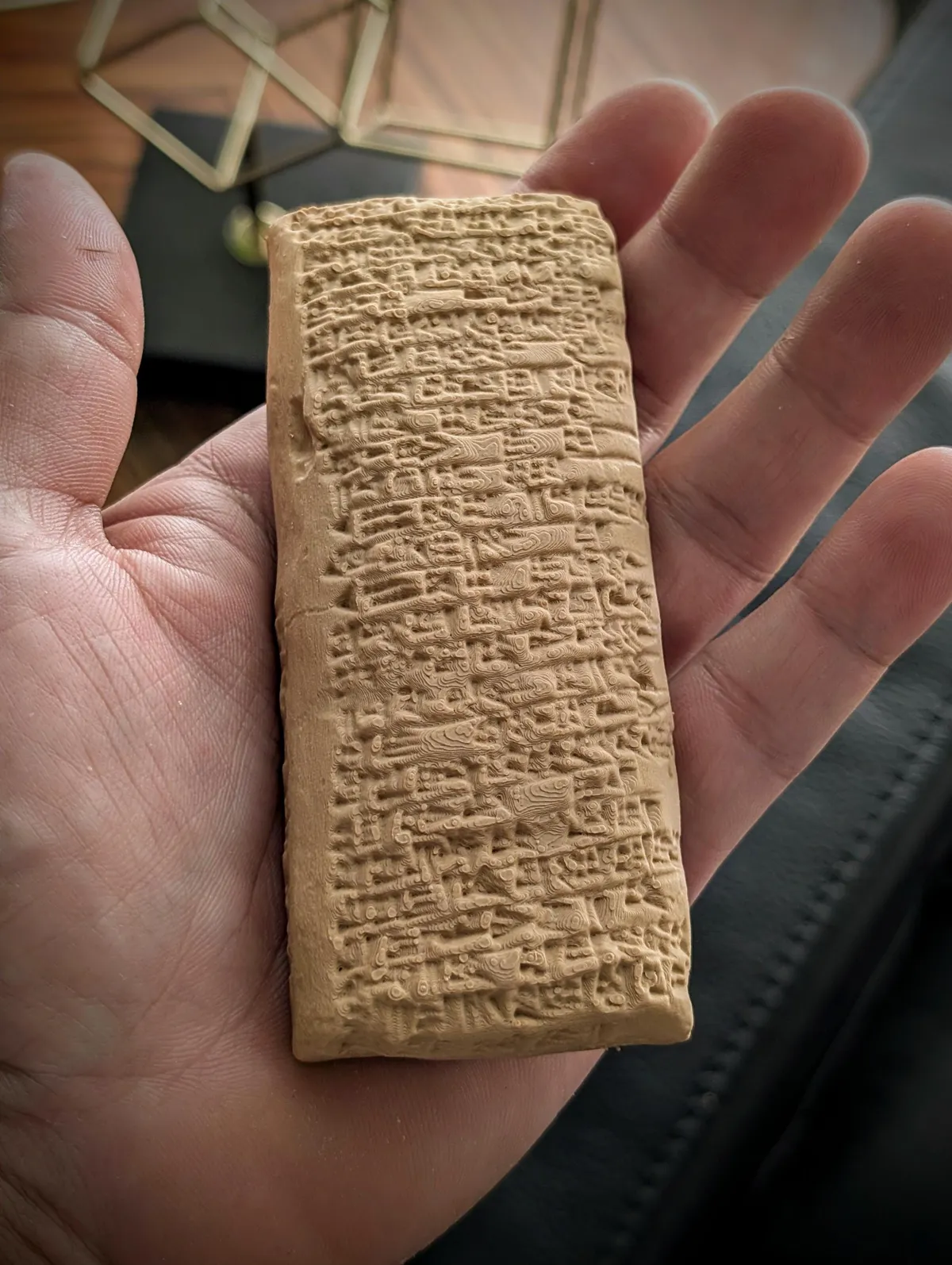
1. Size: is it life-size?
The British Museum measures the original at 11.6 cm high, 5 cm wide and 2.6 cm thick.[1] That's smaller than many people expect: about the size of a phone. A replica much larger than that is an enlargement, which can look good on a wall but feels less like the real thing in the hand. Ours is 11.5 cm tall, 5 cm wide and 2 cm thick: the same height and width as the original, slightly slimmer.[2] See size and materials for a full comparison.
2. Detail: can you read it?
The whole point of the tablet is the writing. Look at listing photos taken in raking light: the wedges should be crisp, with the rows running straight to the edges, as they do on the original.[1] Check which faces are reproduced (the original is inscribed on both faces and the edges) and whether the edges carry text. Ours reproduces the inscribed front face only; the back and edges are not reproduced. If you want to practise reading it, follow our guide how to read the Ea-nasir tablet against the photos before you buy.
3. Material
- Fired or air-dried clay looks and feels authentic but can chip or crack if dropped. The original is unfired clay.[3]
- Resin casts fine detail and is usually heavier, but can look glossy unless finished well.
- 3D-printed composites such as clay-effect PLA are light and tough, and well suited to handling in a classroom.
Ours is made from a solid, sturdy clay-effect composite, designed to stand up to use as a teaching tool or a prop.[2] Each piece is finished by hand in our workshop in Richmond Hill, Ontario, and weighs a hefty 100 g.
4. Colour and finish
Photos of the original show a pale, sandy clay with darker patches.[1] Replicas range from sandy beige to dark terracotta. A matte finish reads more like clay than a shiny one. If you like to customise, a neutral replica is a good base: one buyer told us, in an Etsy review, “I painted it to look plaster and its on my wall.”[4]
5. Display
Think about where it will live. On a desk it can lie flat or stand on its end; on a shelf a small easel or plate stand works well. One reviewer wrote that they love “that it stands too”.[4] For a wall, a shallow shadow box keeps dust off.
6. Honest labelling
A replica should say clearly that it is a modern copy. Genuine cuneiform tablets are cultural property, and anything offered as an “original” deserves serious suspicion. Our listing says it plainly: a modern historical replica, not an original antiquity.[2] We also say what it is not: it reproduces the front face of the tablet only.
7. Price and where to buy
Prices vary with size, material and finishing. Ours is US$24.90 on Etsy at the time of writing; Etsy shows the current price and any sale at checkout.[2] Checkout, payment and shipping are handled by Etsy, and we ship in under 3 days. Before you order, read our shipping and returns page, which mirrors our Etsy shop policy. Buying it as a present? See Ea-nasir gift ideas.
Quick checklist
- Life-size (about 11.6 cm tall) or a deliberate enlargement?
- Crisp, legible wedges in raking-light photos?
- Durable enough for how you'll use it?
- Which faces are reproduced?
- Clearly labelled as a replica?
- Clear shipping, returns and contact details?
Ready? See the Ea-nasir tablet replica, or read the story of the original first. More answers are in the FAQ.
FAQ
How big should an Ea-nasir replica be?
A life-size copy is about 11.6 cm tall, 5 cm wide and 2.6 cm thick, the size of the original.
Is your replica made of clay?
It is a solid clay-effect composite, chosen to be sturdier than real clay.
Does your replica show both faces?
No. It reproduces the inscribed front face only; the back and edges of the original are not reproduced.
Where do I buy it?
On Etsy, from the Ancient3DCrafts shop.